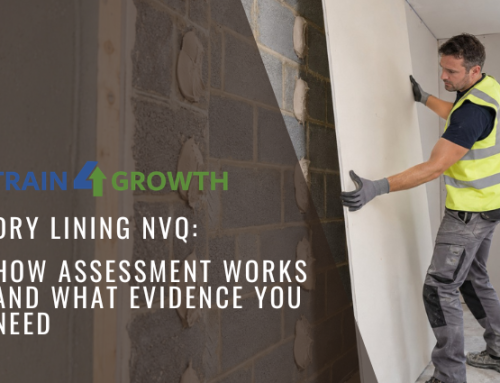
Dry lining is a method of creating internal wall and ceiling surfaces using plasterboard or similar boards. The boards can be fixed to a metal or timber framework or bonded directly to a suitable wall surface.
Unlike traditional wet plastering, most of the surface is formed using boards rather than layers of wet plaster. The boards are then finished by taping and jointing, or sometimes with a skim coat, depending on the system and specification.
If you work on site, you’ve probably seen dry lining happening around you. Metal stud frames going up, boards being fixed, door openings being formed, service boxes being built in, then the surfaces being taped and jointed ready for paint. It’s one of the key interior trades in modern construction because it’s fast, tidy, and suited to today’s building methods.
This guide explains what dry lining is, what dry liners do day-to-day, and how qualifications like on-site NVQs can help you prove your skills and apply for a Blue CSCS Skilled Worker Card.
Why Dry Lining Is Used So Much
Dry lining is popular because it speeds projects up and helps teams keep to programme. Compared to traditional wet plastering, it can reduce drying time and makes it easier to work in phases. It also suits modern building designs that rely on lightweight partitions and suspended ceilings.
Dry lining also plays a part in performance standards on site. Many partition systems are designed to meet fire resistance and acoustic requirements, and dry liners are often working to drawings and specifications to hit those targets.
What Does A Dry Liner Do On Site?
A dry liner’s job is to build the internal structure of rooms before final finishes go on. The exact work depends on the project, but dry lining usually involves setting out, installing frameworks, fixing boards, and preparing surfaces for decoration.
Typical dry liner tasks include:
- Measuring and setting out walls, bulkheads, and ceiling lines from drawings
- Installing metal stud or timber framing systems
- Fixing plasterboard to walls and ceilings accurately and securely
- Forming partitions, openings, and service enclosures around pipes and cables
- Working to fire rating and acoustic specs where required
On many sites, the trade splits into two main roles: fixing and finishing. Some operatives do a mix of both, but it’s common to focus on one pathway depending on the job.
Dry Lining Fixing Vs Dry Lining Finishing
Dry lining fixing is the boarding and installation side of the job. Fixers build the framework and get the boards on. This includes partitions, ceilings, encasements and other internal structures.
Dry lining finishing is the surface preparation side of the job. Finishers tape and joint boards, apply compounds, and get surfaces ready for decoration. A good finish matters because it affects the final look and the snagging at handover.
On some projects, you might see fixers moving quickly through plots or floors, with finishers following behind. On others, smaller teams will cover both stages.
Where Is Dry Lining Used?
Dry lining is used across most parts of the industry, which is one reason it stays in demand. You’ll see it on:
- New build housing developments
- Commercial fit-outs and office refurbishments
- Retail units and shop refurb projects
- Schools, healthcare buildings, and public sector work
- Refurbishments and upgrade work in occupied buildings
If you’re on projects with tight deadlines, dry lining is often a key trade that keeps the inside of the building moving forward.
Is Dry Lining The Same As Plastering?
No. They both sit in the “getting walls ready for decoration” world, but the method is different.
Plastering usually means applying wet plaster to a surface and finishing it smooth. Dry lining uses plasterboard sheets fixed to a frame or bonded to a background, then finished with tape and jointing compounds or skim where required.
Dry lining is common on modern builds and large projects because it is quicker to install and fits well with partition systems and ceiling grids.
Do You Need Qualifications For Dry Lining?
If you’re already working as a dry liner, a recognised qualification can make a real difference. It helps you prove competence on site and can support progression.
Most dry liners work towards an on-site NVQ in Interior Systems. The right option depends on your role and what you do day-to-day.
What NVQ Do You Need for Dry Lining?
The right NVQ depends on the dry lining work you actually carry out.
For working dry liners, the main Level 2 routes include:
Level 2 NVQ Diploma in Interior Systems – Dry Lining Fixing
For operatives installing dry lining systems, plasterboard linings, partitions and related internal systems.
Level 2 NVQ Diploma in Interior Systems – Dry Lining Finishing
For operatives whose work involves finishing dry lining walls and ceilings, including taping, jointing and related finishing work.
The current Level 3 Interior Systems qualification is not simply a higher-level version of the Dry Lining Fixing or Finishing pathways. Its pathways cover specialist interior systems work such as complex suspended ceilings, stretched ceilings and service operable walls.
If your role is developing beyond hands-on dry lining into supervision or other specialist interior systems work, the right next qualification will depend on the duties you actually carry out.
Train 4 Growth can check your job role and help you identify the qualification that matches your work before you enrol.
Can a Dry Lining NVQ Help You Get a Blue CSCS Card?
Yes. The relevant Level 2 Interior Systems qualification can meet the qualification requirement for the Blue CSCS Skilled Worker Card for occupations including Dry Lining Boarder, Dryliner Fixer and Dryliner Finisher.
You will also need to meet the current CSCS requirements for your occupation, including passing the appropriate CITB Health, Safety and Environment test.
If you want to understand the card route in more detail, read our guide to CSCS cards for dry liners.
How On-Site NVQ Assessment Works
On-site NVQ assessment is built around what you do in the real world. You keep working as normal and collect evidence as you go. Your assessor will guide you on what’s needed and how to present it clearly.
Evidence can include:
- Photos and videos of your work at different stages
- Job sheets, drawings, or method statements where relevant
- Witness testimonies from supervisors or managers
- Professional discussions to confirm knowledge and decision-making
Because it’s based on live site work, it tends to be a straightforward route for experienced dry liners who are already doing the job.
How Long Does It Take to Complete a Dry Lining NVQ?
There is no single fixed completion time for a dry lining NVQ. How long it takes will depend on your experience, the pathway you are completing and how quickly you can gather evidence across the required workplace tasks.
If you are already carrying out suitable dry lining work regularly, your assessor can build the assessment around your normal job and help you identify the evidence still needed.
Next Step: Dry Lining NVQs With Train 4 Growth
If you work in dry lining and you want a clear route to a recognised qualification, take a look at our trade page. It explains the NVQ options and links to the relevant courses.
Dry Lining Courses And NVQs For Blue CSCS Card
If you’re not sure which NVQ fits your role, call 0161 706 1401 or send us a message and we’ll talk you through it.